Rosettes, Round 2
Tuesday, December 18, 2012
After making a double batch of rosettes yesterday and being less than completely satisfied with the results, I decided on another batch this morning. My dissatisfaction with yesterday's efforts was due to bubbles – like blisters – on them.
I consulted with the bakers on Facebook's Baking 101 (a locally-based site where bakers can get good information from pros who shill their products and sites, as well as from talented amateurs). I mentioned that I let my batter sit after mixing it; I mentioned straining it after mixing. The recipe (an old Betty Crocker recipe from Betty's 1963 Cooky Book) calls for straining the batter; it does not say anything about letting it stand (I must have gotten that from my crepe batter recipe which does have a stand time for the batter). There was speculation on the group that perhaps the stand time promoted the bubbles, since pancake batter that stands produces fluffy pancakes. My rosette batter doesn't have any chemical leaveners, though, as pancake batters do, so I am skeptical about that. In fact, I believe at least part of the reason for stand time when making crepes is so any bubbles will dissipate.
Well, the curious cat bit me in the bum and I decided I would try it again, frying immediately after mixing the batter. I made another change in my method, too. This morning I used a hand beater to mix the batter, rather than vigorous whisking as I did yesterday. I know, I know, the beater could incorporate air into the batter that would again lead to bubbles, but I was using it slowly and I again strained the batter to remove small unincorporated clumps.
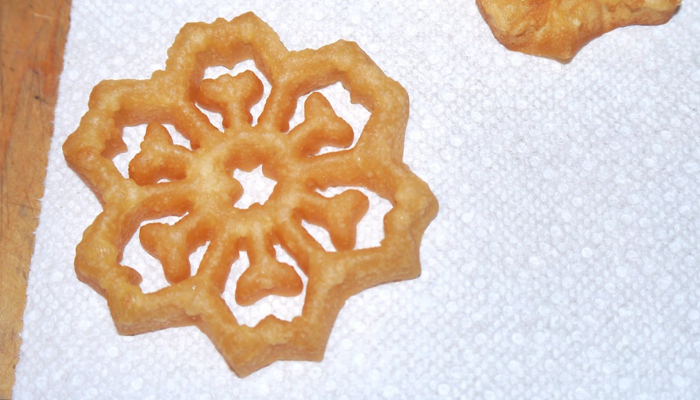
There is a considerable difference in the outcomes. Today's big ol' snowflake rosettes are nearly bubble free. Enough so that I'm content with their appearance.
I'll be marking the change in my Cooky Book.
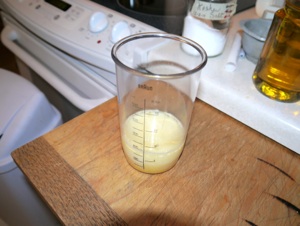
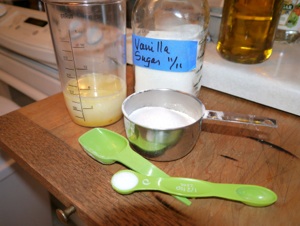
In the first picture, the egg, oil and milk. Second picture is of the liquids and the dry ingredients. I used vanilla sugar today instead of plain. I’m not certain I can discern a different flavor, though.
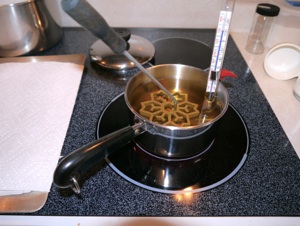
Heat the iron in the oil — I heat it for a minute or two when the oil is coming up to temperature (375-400°). The oil set up you see has all the making of a disaster and I do not recommend you do it this way. While this particular burner set can accommodate a small pan and just heat the center, the outer part does get got and the bubbling oil would no doubt explode into fire if it boiled over. Believe me I watched it like a hawk — and moved it off the burner more than once as the bubbling was too high for my comfort. Heed my words. Best to use a larger pan that fits the whole burner (as I did yesterday). One reason I didn’t do that today is because I wanted to reuse yesterday’s (filtered) oil again and it would not have been as deep as I wanted it to be had I used my big Revere Ware saucepan.
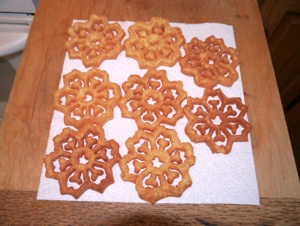
Look, aren’t these pretty? You can actually discern a snowflake; the rosettes did not blister as they did yesterday — not nearly so. Because the snowflake form is rather large, I made only about 11 cookies from the batch. I could have eked out at least one more, but the batter in my dish was not deep enough to sufficiently cover the iron. Dang!
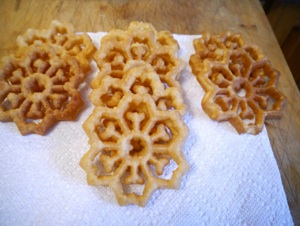
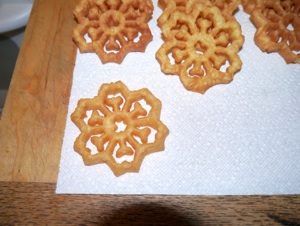
I will make a note in my book to not use a whisk and to not let the batter stand before frying. I’m guessing one or the other is responsible for my bubbled and blistered fried delicacies, and eliminating both should pretty much cover me.
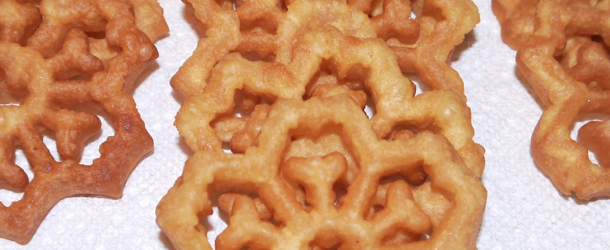
The Quality Control Inspector has sampled the goods and he approves. Too bad most of these are for gifts. “Have a gingersnap, Honey.”